Lapka
The short answer
Eating grass is normal for most cats, and nobody fully understands why. The likeliest ideas are that it helps move fur and other things they can’t digest through the gut, up or down, and that it’s an instinct inherited from wild ancestors. Cats can’t digest much grass, so some bring it back up. Most look perfectly well beforehand. See your vet if your cat vomits more than once a week, or seems unwell or off their food.
Why do cats eat grass?
Cats eat meat, yet many of them like to chew grass. International Cat Care calls it a normal behaviour that isn’t fully understood. The usual explanation is that grass helps move food or hairballs through the gut, either up or down.
Cats Protection, a UK cat charity, explains the digestion idea with prey. A cat who catches a mouse or a bird eats most of it, bones and fur or feathers included, and those are hard to digest. So is the fur a cat swallows while grooming. Grass can help bring it all back up, or act as a natural laxative so it passes more easily.
Cats Protection adds that grass contains nutrients such as fibre and folic acid, which may be why cats are drawn to it, though a complete cat food should already have everything they need. PDSA’s vets mention a similar idea about trace elements and say there’s no real evidence for it. Some people think cats simply like the taste.
How many cats eat grass?
Most of them. Researchers at the University of California, Davis, School of Veterinary Medicine ran two online surveys of cat owners, in 2006 and 2016, and only counted owners who had known their cat for at least 11 months and could see them for three or more hours a day. In the second survey, 1,021 of 2,296 answers were left after these checks. 71% of the cats had been seen eating plants at least six times, 61% more than ten times, and only 11% never.
In the first survey, 65% of cats ate plants every week. For cats a year old or more, grass was the plant eaten most often. Kittens under a year chewed other plants more, and International Cat Care says kittens and bored cats are more likely to eat harmful plants, particularly houseplants.
Young cats eat plants more often than older ones. In the second survey, 39% of cats aged three or under ate plants every day, against 27% of older cats.
Why do cats eat grass and throw up?
Cats can’t digest large amounts of grass, so eating it may make them throw up. Cats Protection says a cat who eats grass and then vomits is usually doing it on purpose. It clears the stomach of things that irritate it, such as fur, feathers, bones or parasites, and afterwards they feel better.
International Cat Care notes that any plant, grass included, can irritate a cat’s stomach and intestines and cause vomiting. In the first UC Davis survey, among cats over a year old who often ate plants, owners had seen plants in the vomit of 69.4% and in the droppings of 34.4%.
How often it happens depends on age. In the UC Davis surveys, 27% and 37% of cats often vomited after eating plants. In the first survey it was 2.7% of kittens under a year; in cats over nine, 57.1%.
Do cats eat grass to make themselves sick?
That’s the oldest explanation, and the surveys put it to the test. If cats ate grass because they felt ill, their owners would see them looking unwell first. Few did. In the first survey 6% of cats appeared ill before eating plants, in the second 9%. Between 91% and 94% looked their normal selves.
The researchers concluded that this doesn’t support the idea that plant eating is triggered by feeling ill. They did find the vomiting common enough to suggest that, in some cats, an upset stomach sometimes sets off the grass eating and the vomiting after it.
Is it about hairballs?
Cats Protection’s guide to indoor and outdoor cats repeats a common belief: grass helps cats cough up hairballs. Long-haired cats swallow more hair and bring up more hairballs, so if that were the reason, they should eat more grass. In the second survey they didn’t. Domestic short-haired and long-haired cats ate plants just as often, and vomited after it just as often. The researchers say the data don’t support the hairball idea.
Hairballs on their own are normal in moderation. Cornell’s Feline Health Center says it’s not uncommon for a cat to bring one up once every week or two. Long-haired breeds such as Persians and Maine Coons may be more prone to them, so Cornell suggests brushing and combing your cat’s coat every day.
An instinct from wild ancestors
The UC Davis team’s answer is that eating plants is a normal, common behaviour in cats, as it is in dogs, and presumably innate. Wild cats and other carnivores do it too. A review of 352 studies found evidence of fibrous plants eaten by 124 species of carnivores, and 81 of those studies were on the cat family, including lynx, pumas and leopards.
The idea is that grass helps clear worms from the gut. A biologist studying wolves found blades of grass wrapped around intestinal worms in their droppings. Nearly all wild carnivores carry some worms, so a regular nibble of grass would help keep their numbers down, even though the animal can’t feel them. It would also explain why young cats eat grass more often: in the wild, parasites cost the young the most.
It stays a theory, because the researchers say a direct test isn’t feasible. But it fits a cat who chews grass and looks perfectly well.
Why does my cat eat grass every time he goes outside?
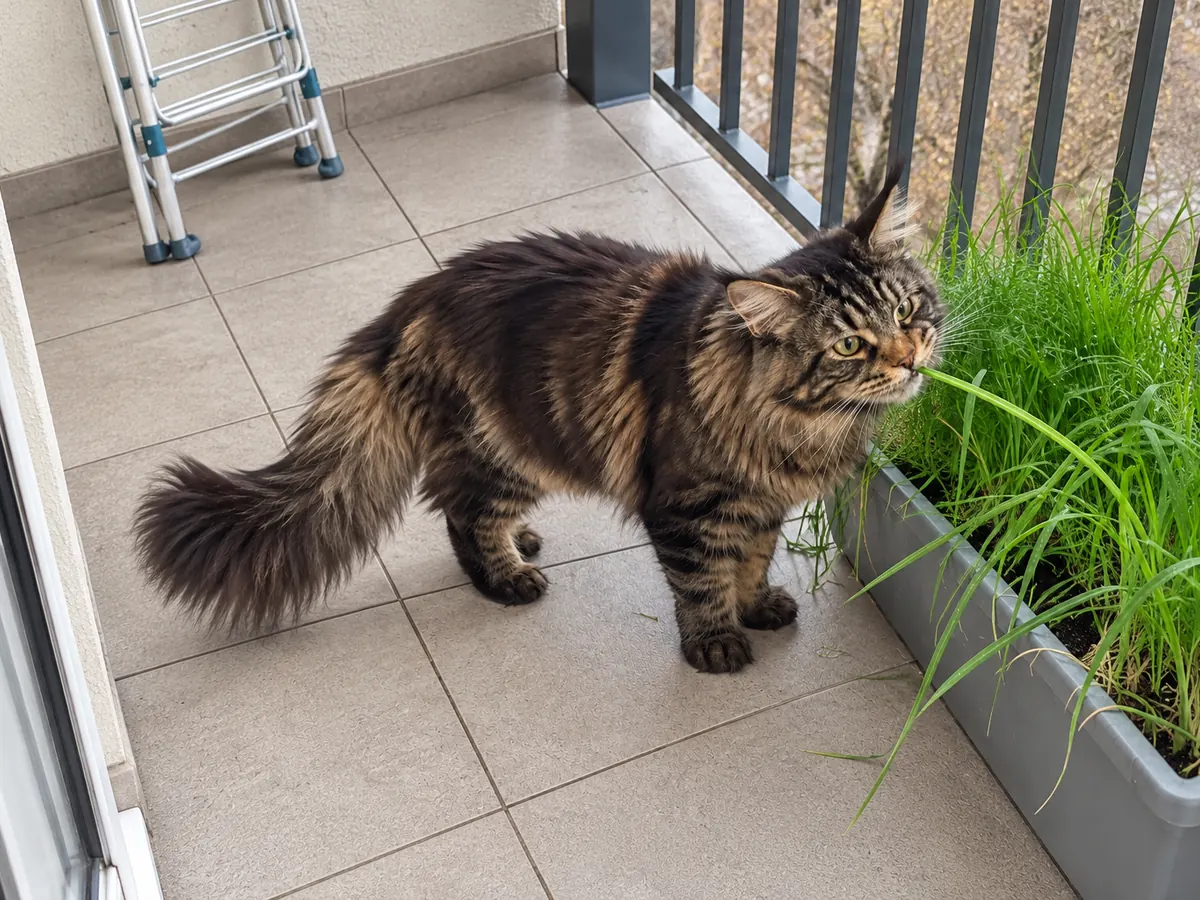
Because it’s there. The UC Davis researchers think most cats have a steady urge to eat plants, and Cats Protection says most cats need no encouragement to chew grass when it’s easy to reach. It’s a natural behaviour, and Cats Protection advises against discouraging it, as long as the grass hasn’t been treated with weedkillers or pesticides.
Outside, a few things are worth watching. Grass seeds appear in summer and can get stuck in a cat’s ears, nose, eyes and paws and cause serious problems. A blade of grass breathed in by accident can lodge in the nose and make your cat sneeze a lot; take them to the vet to have it removed. And arrow grass, found mostly in marshes and near the sea, is poisonous to many animals in large amounts.
Cat grass for indoor cats
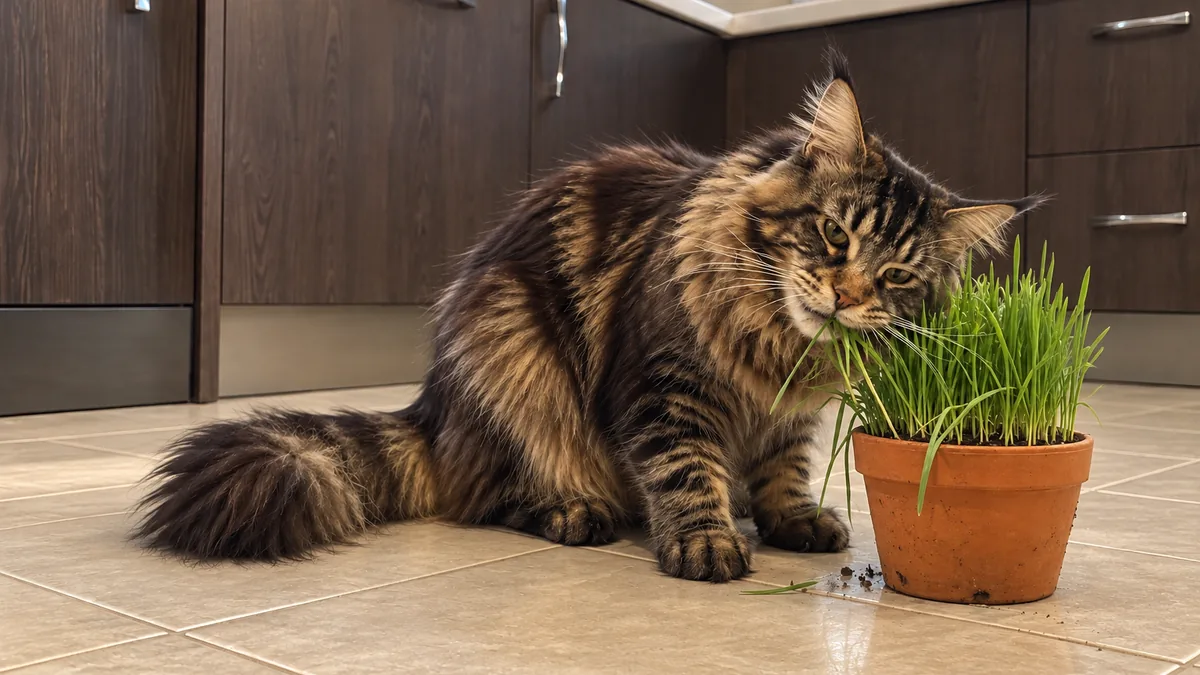
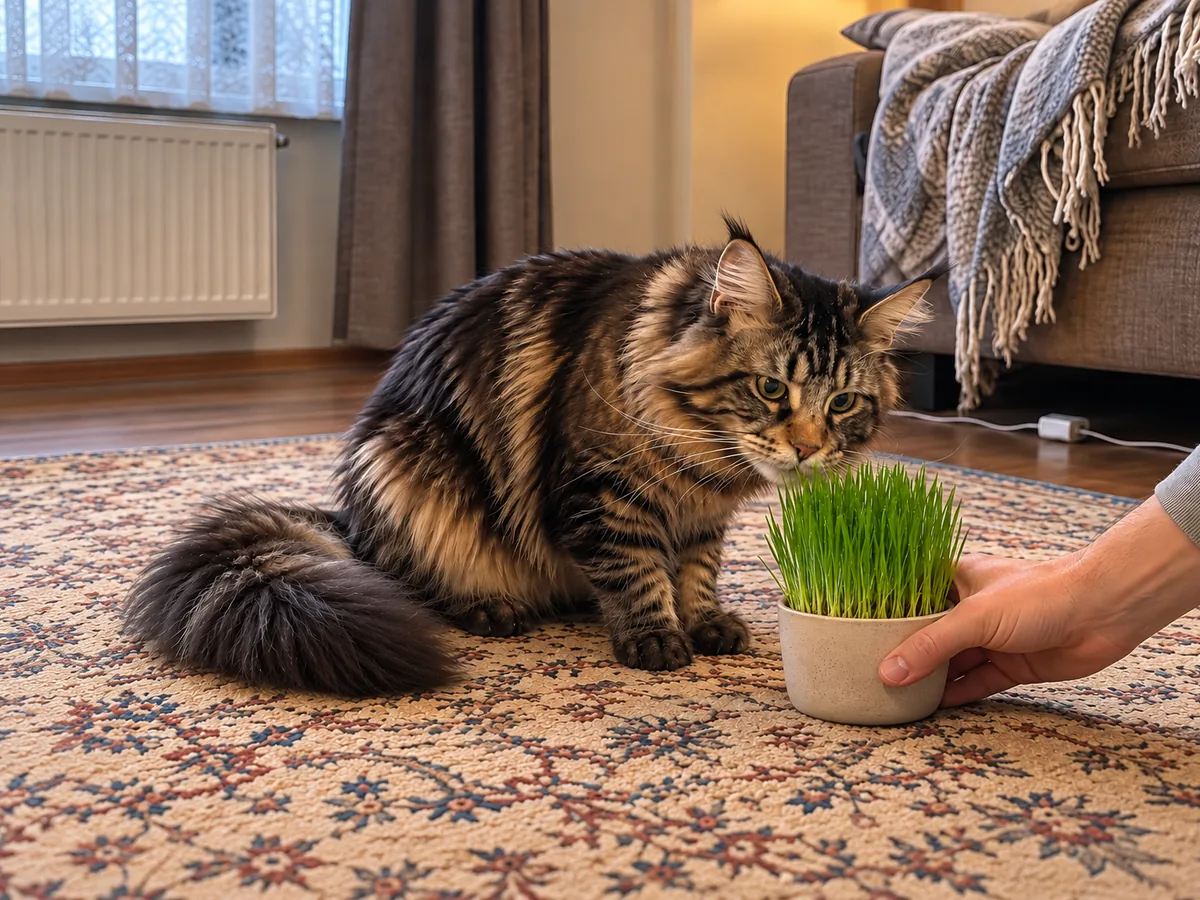
An indoor cat still has the urge to chew plants, and the UC Davis researchers say a pot of grass seems reasonable for a cat with no outdoor access. In their second survey, 33% of owners whose cats often ate plants gave them a bed of grass regularly, and 35% of those owners said their cat “enjoyed” it.
International Cat Care suggests a commercial pack of cat grass, or a pot of grass grown from seed or brought in from the garden. Cats Protection names cocksfoot grass, whose seeds you can buy in garden centres and pet shops. Grow it yourself or buy it sold as cat grass, and you know nothing has been sprayed on it.
Put the pot where your cat already spends time and let them find it. Cats Protection says to give your cat the choice and never force them. Some cats don’t feel the need, and if yours ignores it, that’s fine.
Keep houseplants out of reach
Most cats are careful about what they eat, and International Cat Care says poisoning is generally rare. But a cat with no grass to chew may turn to houseplants they’d usually leave alone, and some of those are poisonous. The charity names dieffenbachia (dumb cane) and lilies as especially dangerous.
International Cat Care calls lilies extremely dangerous. Every part is toxic: pollen, flowers, stem and leaves. Eating less than one leaf, or even drinking the water from a vase of cut lilies, can be fatal, and ‘pollen-free’ lilies are still unsafe and best avoided just the same. Before you bring a new plant home, look it up on the ASPCA’s list of safe and poisonous plants, the one the UC Davis researchers point owners to.
Cat grass helps here too: Cats Protection says it can distract your cat from nibbling the plants you’d rather they left alone. If you’d like your cat to come when you call, which is handy when they’re heading for a plant, a Lapka programme plans short daily sessions and adjusts them after each one.
When to see a vet
A cat who chews some grass, brings it up and gets on with the day is doing something very ordinary. What’s worth a vet visit is a pattern. Cornell’s Feline Health Center says a cat who vomits more than once a week, or who also seems lethargic or weak, eats less, has blood in the vomit, drinks more, wees more or less than usual, or has diarrhoea at the same time, should see a vet promptly.
Don’t wait if your cat refuses food for more than a day or two, or keeps retching with nothing coming up: Cornell says that needs a vet without delay. Grass can also get stuck in a cat’s gut, so Cats Protection’s advice is to take any cat who seems unwell after eating it to the vet.
If you’re worried your cat has chewed a poisonous plant, call your vet. International Cat Care lists the signs to watch for: collapse, vomiting, diarrhoea, drooling, redness, swelling or blistering of the skin, mouth or throat, a smaller appetite and tiredness. If you see any of them, call straight away. Don’t try to make your cat sick. Take the plant’s label if you have it, and note the time they ate it.
What a week of notes on grass can look like
Mon, 8:10: chewed the cat grass after breakfast. At 8:25 brought up a little grass with some fur on the kitchen floor. Played and ate dinner as usual.
Thu: nibbled the grass twice, no vomiting.
Sun, 9:00: grass again, brought it up once. Eating, drinking and litter tray all as usual.
Notes like these show how often your cat brings grass up and whether anything else has changed. Twice in one week is more than Cornell’s once-a-week line, so this is a week to mention to the vet.
Questions people ask
What does it mean when a cat eats grass?
Usually nothing worrying. Eating grass is normal and very common: in the UC Davis survey, only 11% of cats had never been seen eating plants. It may help move fur and other things they can’t digest through the gut, and it’s probably an instinct cats share with wild carnivores.
Why does my cat eat grass every day?
Plenty of cats do, especially young ones. In the UC Davis survey, 39% of cats aged three or under ate plants every day, and 27% of older cats. If your cat eats well and only brings grass up now and then, there’s nothing to change. If they vomit more than once a week, see your vet.
My cat is eating grass but not food. Should I worry?
Call your vet. Cats Protection says a cat who vomits and also seems off their food should be checked, and Cornell says a cat who refuses to eat for more than a day or two should be seen without delay.
Do cats eat grass when they’re sick?
Usually not. In the UC Davis surveys, only 6% and 9% of cats looked ill before eating plants. In cats over nine it was a little more, 9.4%. A cat who seems unwell, grass or no grass, needs a vet.
Is grass bad for cats?
Grass itself is safe, Cats Protection says, unless it has been treated with weedkillers or pesticides. The risks are grass seeds in summer, a blade stuck in the nose and, rarely, arrow grass near marshes and the sea. A pot of cat grass you grow yourself has had nothing sprayed on it.
Should I stop my cat from eating grass?
No, unless the grass has been sprayed. Cats Protection calls it a natural behaviour and says it’s best not to discourage it. Indoors, a pot of cat grass gives your cat something safe to chew instead of your houseplants.
Sources and further reading
- University of California, Davis — Characteristics of Plant Eating in Domestic Cats (Animals, 2021)
- Cats Protection — Why do cats eat grass?
- Cats Protection — Indoor and outdoor cats (Essential Guide 12)
- PDSA — Weird things cats do
- International Cat Care — Why do cats..?
- International Cat Care — Poisonous plants
- Cornell Feline Health Center — Vomiting
- Cornell Feline Health Center — The danger of hairballs