Lapka
Lapka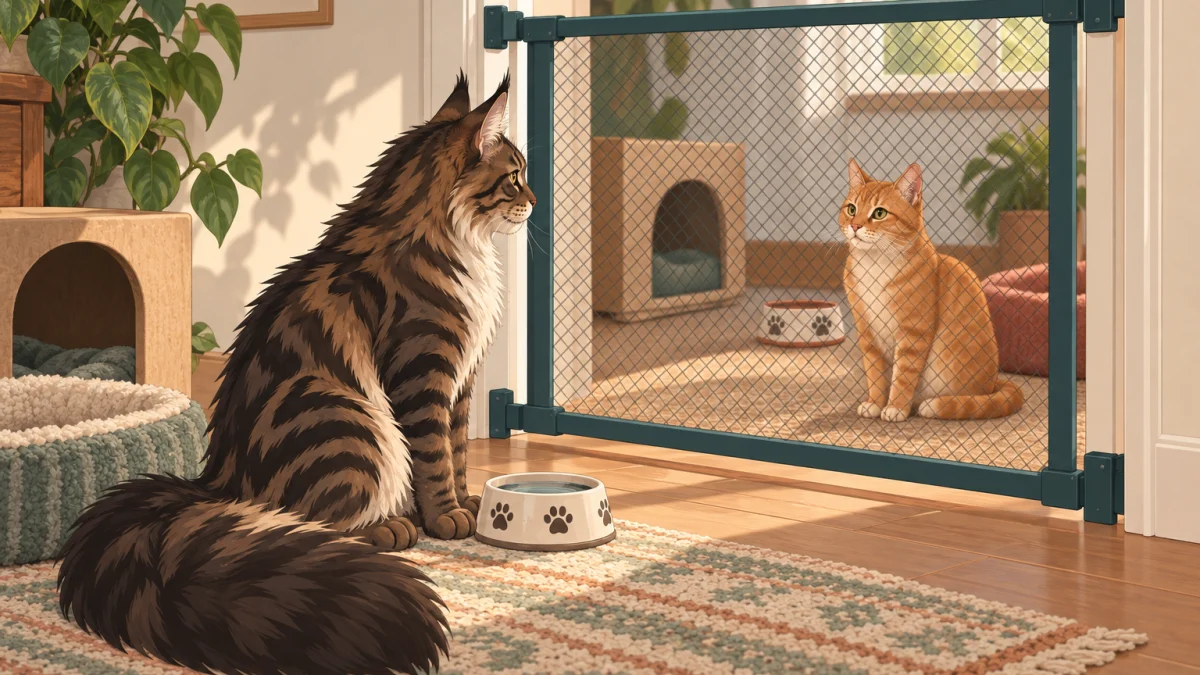
Where to start
Begin with separate rooms and complete resources for each cat. Exchange scent before visual contact, then use a secure mesh barrier for short calm sessions. Progress only while both cats can eat, rest and move away normally; if tension grows, add distance or return to the last comfortable step.
Prepare two complete territories
Set up a base room for the newcomer before the cats meet. It needs food, water, a litter tray placed away from food, a bed, a hiding place, a scratching surface and somewhere elevated if possible. The resident cat keeps access to their usual territory and resources. A closed solid door gives both animals time to settle without being forced into contact.
In a multi-cat home, access matters as much as the number of objects. Place resources in separate locations so one cat cannot guard a single doorway and control everything behind it. A commonly recommended starting point is one of each essential resource per cat plus a spare, distributed around the home rather than lined up together.
Let the new cat settle first
A cat who is still hiding, barely eating or afraid to explore their room is not ready for a harder social step. Spend quiet time in the base room, keep the routine predictable and let the newcomer choose when to approach. The resident cat also needs normal attention and places where the household still feels familiar.
There is no useful deadline such as “they must meet on day three”. Personality, previous experience and the home all change the pace. Progress is shown by ordinary behaviour returning: eating, toileting, grooming, playing and resting without staying fixed on the door.
Introduce scent before sight
Use a clean cloth to collect scent gently from the cheek area of one relaxed cat, then place it in the other cat's space at a distance. You can also swap bedding or allow each cat to explore the other's room separately while the other is secured elsewhere. Never push a scented object into a cat's face.
Observe choice. Sniffing briefly and walking away is a perfectly useful response. If the cat can investigate and then continue eating, playing or resting, the scent is becoming part of the environment. If they freeze, hide, guard the object or stop normal activities, create more distance and slow down.
Build a positive pattern at the closed door
Offer something each cat already enjoys on their own side of the solid door: a small part of a meal, a treat, calm play or quiet attention. Start far enough away that both can participate comfortably. The purpose is not to lure them into distress, but to let the other cat's presence predict an ordinary good experience.
Keep sessions short and remove the setup when it is over. If one cat will not eat near the door, move the bowls farther away instead of waiting them out. Distance is a training variable, not a failure.
Move to a secure visual barrier
When both cats remain comfortable with scent and the closed-door routine, use a mesh-covered baby gate, screen door or another barrier that prevents physical contact. Check that neither cat can jump over, squeeze through or pull the barrier down. Begin with a partial view or extra distance if a full doorway is too much.
Look for soft, flexible behaviour: brief glances, sniffing, accepting food, turning away, grooming or choosing to leave. A stare that does not break, blocked movement, flattened ears, a lashing tail, growling, repeated hissing or charging the barrier means the session is too difficult. End without punishment and make the next exposure shorter or farther apart.
Try shared space only after calm barrier sessions
For the first sessions without a barrier, choose a room with more than one exit path and high or covered places. Keep the meeting supervised and brief. Use toys or rewards separately rather than making the cats compete over one object. Do not hold either cat in place or carry one towards the other.
Finish while both cats still have choices. Peaceful coexistence may look uneventful: they notice each other and continue with something else. Nose touching, sleeping together or mutual grooming are not required milestones. Some cats become companions; others do well by sharing a home at a respectful distance.
Respond to a setback by reducing pressure
A hiss is communication, not proof the introduction is ruined. Increase distance, restore the barrier or return to scent work. After a chase or fight, separate the cats safely without putting hands between them, allow a full calm-down period and rebuild from an earlier stage. Do not punish either cat for warning signals.
Persistent blocking, stalking, attacks, hiding, loss of appetite or toileting changes need more than repeated meetings. Speak with a vet to rule out health problems and seek a qualified feline behaviour professional. The aim is a safe household, not forcing a relationship on a schedule.
Record what each cat could do
Track both cats separately: distance, duration, barrier, food or activity offered, body language and how the session ended. “Both ate two metres from the mesh for three minutes; orange cat left first; no following” gives you a repeatable starting point. “They seemed better” does not.
Lapka can use the cats' context and your goal to organise a personal introduction programme. Record difficult sessions too, because a step that was too large is exactly the information needed to make the next one smaller.
A first barrier-session note
Setup: secure mesh gate, beds and bowls on separate sides, two metres between cats. Duration: three minutes. Maine Coon: looked twice, ate, then groomed. Orange cat: ate, watched briefly, walked into hiding box. End: closed the solid door before either cat approached the mesh.
Next step: repeat the same distance. Do not move closer simply because there was no fight; first look for the same calm choices across more than one session.
When it does not go to plan
How long does introducing two cats take?
There is no fixed schedule. Some pairs move through the stages quickly; others need weeks or longer. Let normal eating, resting, play and the ability to disengage decide the pace, not a calendar date.
Should I let them fight it out?
No. A fight can add fear and make future meetings harder. Use barriers and distance to prevent physical conflict. If a fight starts, avoid putting your hands between the cats; interrupt from a safe distance and separate them until fully calm.
Is hissing always a bad sign?
Hissing communicates a need for distance. One hiss followed by disengagement is different from repeated charging, blocking or pursuit. Treat it as useful feedback: end or simplify the session and do not punish the warning.
Will my older cat accept a kitten more easily?
A kitten may appear less threatening, but high kitten energy can still overwhelm an adult cat. Give the older cat protected rest, high places and separate resources, and follow the same gradual process instead of assuming the age difference guarantees friendship.
Sources and further reading