Lapka
Lapka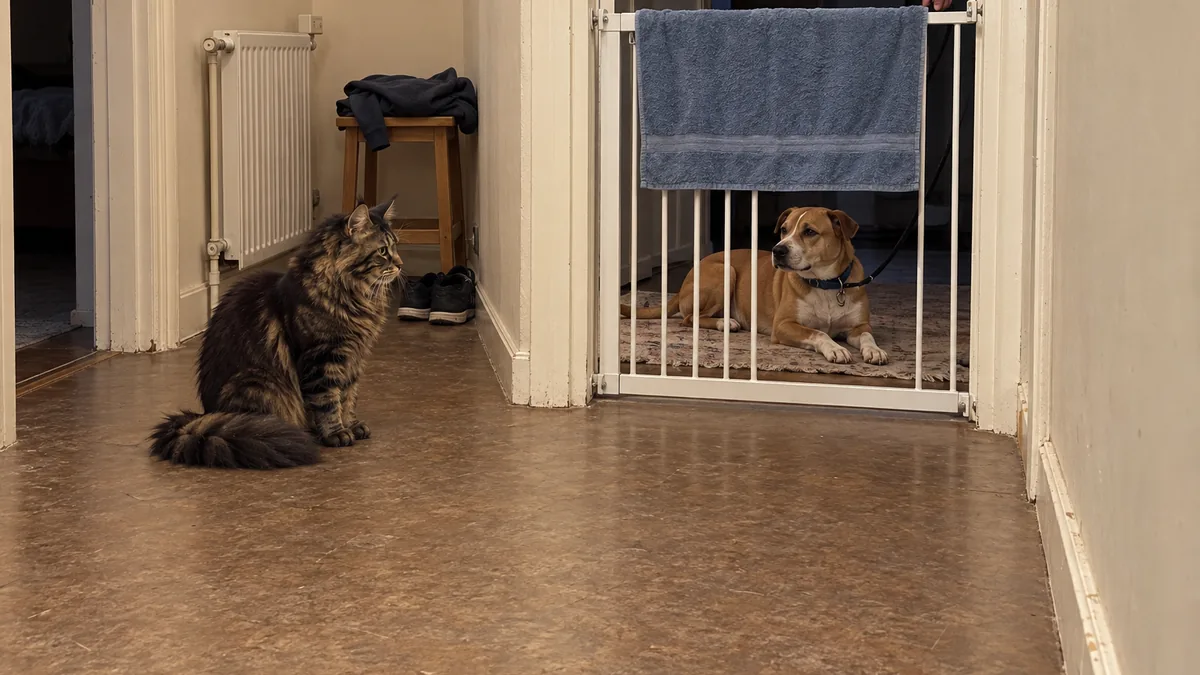
Where to start
Let your scared cat set the pace. Give them a room the dog can’t enter, with high places and somewhere to hide. Swap scents on cloths until neither pet reacts. Then let them see each other through a baby gate, starting with five minutes, with the dog on a lead. Meet in one room only when both stay relaxed, and let your cat leave whenever they like. If your cat backs away or hisses, don’t move on.
Can a scared cat and a dog live together?
Often, yes. Cats Protection, a UK cat charity, says it can be easier to introduce a cat to a dog than to introduce two cats. International Cat Care says close relationships between dogs and cats usually come from good early experiences with the other species and carefully managed introductions. If your cat has lived happily with a dog before, that can make it easier.
Some cats are better off alone. PDSA, a UK vet charity, says that if your cat is generally nervous, has had bad experiences before or already has stress-related health problems, it might be best for them to stay the only pet, because a new dog could cause them a huge amount of stress and make them ill. The dog matters too: terriers and chasing breeds such as greyhounds may be more driven to chase, and PDSA says a very excitable dog, or one who likes chasing cats, might be better without one.
Set your sights on peace rather than friendship. International Cat Care says the goal is for both animals to live happily in the same space, each doing their own thing, without lots of interaction.
Before they meet: a dog-free room for your cat
Give your cat a room the dog can’t get into. For a new cat, Cats Protection suggests a spare room away from noisy appliances and busy parts of the home, with a bed or blanket, a litter tray, food and water bowls, and somewhere to hide, like a cardboard box with holes in it. If your cat already lives with you, International Cat Care says their safe space should be where they normally choose to be.
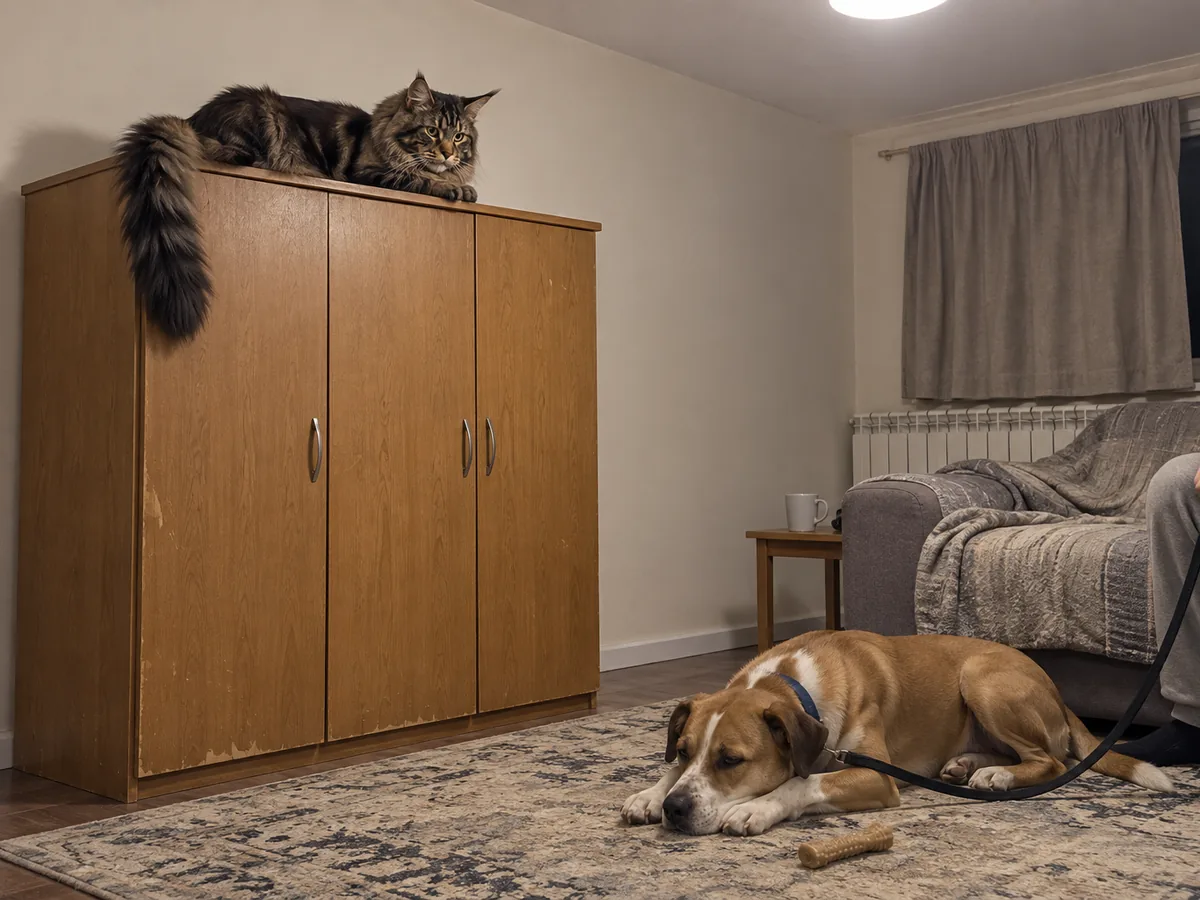
Cats feel safer up high. Clear the top of a wardrobe or a shelf, or put up a cat tree, so your cat can watch from above. The dog gets their own part of the home, but not a space so small that they get frustrated.
Keep your cat’s routine as it was, and keep spending time with them, little and often: a game, a puzzle feeder, a stroke if they come to you asking for one, or a short one-to-one training session. If your cat enjoys learning tricks, a Lapka programme plans those few minutes and adjusts them after each one.
If the dog is the newcomer, Battersea suggests keeping the two completely apart for at least two to three weeks before careful introductions begin. It takes a dog an average of three weeks to destress and start settling in.
Swap scents before they meet
Dogs and cats rely heavily on smell, so let them meet by scent first. The RSPCA recommends swapping scents before the new pet even comes home. Take two clean cloths and wait until each pet is calm, because the RSPCA says an animal’s stress otherwise ends up in its scent. Rub one gently on your cat’s cheeks and forehead, and the other on the dog’s armpits and along their sides. Put the cat’s cloth in the dog’s area and the dog’s cloth in your cat’s room, and let each of them sniff it, ignore it or walk away.
Do it once a day so the smell stays fresh. Later you can dab the cloths on furniture around the home too. Keep the dog’s cloth away from your cat’s food and water bowls: International Cat Care warns it can make a cat anxious enough to stay away from them.
When neither of them reacts to the smell any more, move on. A nervous cat may need longer than the dog. Until then, keep swapping.

How to introduce a cat to a dog for the first time
The first look happens through a barrier they can see through but can’t get past: a baby gate, a glass door or a sturdy screen door. International Cat Care suggests a baby gate mostly covered by a draped towel, so they only glimpse each other at first, and keeping a distance between them.
Have two people, one for each pet. Keep the dog on a lead and reward them for staying calm. A good walk beforehand may help them settle, and Battersea says a long-lasting chew may help keep a dog calm and busy. Don’t carry your cat to the gate. Battersea suggests waiting until your cat has chosen to rest somewhere outside their room, then bringing the dog to the other side.
Start with five minutes. If both stay relaxed, add about a minute each time, over several days. Stop while they’re still calm. Cats Protection says it’s better to end early on a good note than to carry on until something goes wrong.
The first meeting in the same room
Only meet without the gate when both stay relaxed behind it. Keep the dog on a lead and make sure they can’t reach your cat even at its full length. Close outside doors and windows so your cat can’t bolt. Your cat needs a way out and somewhere high the dog can’t reach, like a shelf or the top of a wardrobe, and they should be free to leave the room whenever they want.
Never hold your cat or push them towards the dog, and don’t put them in a carrier. Many cats already dislike carriers, and being shut in takes away the chance to run or hide. International Cat Care says a cat should never be put in a crate for these meetings.
Pay attention to the dog rather than the cat. Cats Protection says fussing over your cat can make the dog think the cat is more important. Ask the dog to sit or lie down and reward calm behaviour. Give your cat treats too, so the dog comes to mean something good. If your cat runs off, don’t let the dog follow.
Keep it short. After a few minutes, one person spends time with the dog while someone else makes a fuss of your cat in another room. Battersea suggests repeating short meetings like this two or three times a day for the first few days.
Cat scared of the new dog? Signs to stop and step back
Keep a close eye on your cat. Cats Protection lists the signs of a stressed cat: backing away, ears down, wide pupils, hissing and swiping. A relaxed cat has normal-sized pupils, ears facing forwards and a loose, easy body.
Watch the dog too. A fearful dog may hold their tail low, show the whites of their eyes or growl. A dog who is too interested may pull hard on the lead, fix their gaze on your cat or look ready to chase. If the lead goes tight, International Cat Care says to end the session and try again with more space between them.
If either of them reacts strongly, don’t move on to the next step. Let your cat go back to their room or up high and watch from a distance. You may have to go back a step, to the gate or to the cloths, and that’s fine. Don’t grab either pet or tell them off. International Cat Care says swooping in raises the tension, and Battersea says punishment can just create fear.
How to introduce a scared cat to a puppy
The same steps work with a puppy, and an early start helps. A Tel Aviv University study of homes with both a dog and a cat found that relationships seemed friendlier when the cat arrived before the dog, and when they first met young: up to 6 months old for the cat and up to 1 year for the dog.
Puppies are bouncy, so set the home up for it. Give your cat plenty of high hiding places: Cats Protection says the tops of wardrobes and shelving are ideal. A baby gate, or a cat flap in an inside door, lets your cat reach a dog-free room. Put the puppy’s bed away from your cat’s things, and move your cat’s food and litter tray out of the puppy’s reach.
Before a meeting, make sure both have eaten, since a fed pet is more likely to be relaxed, and take the puppy for a long, relaxed walk. Skip games of fetch, which fire up the urge to chase. Teach the puppy to sit or lie down and reward them for it, keep the sessions short, and repeat them. Don’t rush any step.
How to introduce a cat to a dog in an apartment
A small flat can work, but your cat still needs a room of their own. Battersea says that in flats the cat would ideally have its own room, with food, water, a litter tray, a bed and a scratching post. An extra litter tray means your cat doesn’t have to leave their safe place before they’re ready to meet the dog.
Where floor space is short, use the walls. Shelves, cabinets and the tops of wardrobes become escape routes, and PDSA suggests tiered cat trees or wall-mounted shelves, so your cat can watch what’s going on below from somewhere safe. A baby gate across a doorway keeps the dog out of your cat’s room.
Keep food, water and the litter tray away from the dog’s things and out of their reach, because cats prefer to eat on their own. The dog shouldn’t be shut in one small room either: Cats Protection warns a cramped space can frustrate a dog.
When to ask for help
If your cat is still hiding or hissing after you’ve slowed right down, or the dog can’t take their eyes off your cat, get help sooner rather than later. Cats Protection says to contact your vet first to check for medical issues, then ask for a referral to a qualified cat behaviourist. It’s much easier to manage a slow introduction than to repair a bad start.
Never leave the two alone together until you’re completely sure they’re happy and secure in each other’s company. In some homes a dog and a cat never quite tolerate each other, and Cats Protection says they may then need to be kept apart.
What two weeks of notes can look like
Day 2: swapped cloths. She sniffed the dog’s cloth and walked off with her ears down. He licked hers.
Day 6: she slept next to his cloth. First session at the gate, towel over most of it, 5 minutes. She stayed on the shelf, ears forward.
Day 10: gate at 9 minutes. She came down and ate a treat a metre from the gate while he chewed on his mat.
Day 13: first try in the living room, dog on a lead. She backed away and went up the wardrobe. We stopped after three minutes and went back to the gate.
Notes like these show where your cat’s limit is today and whether it’s moving. Here the gate is working and the shared room came too soon, so the next step is more time at the gate.
When it does not go to plan
My cat is scared of my dog. What should I do?
Give your cat space and height first: a room the dog can’t enter, a high shelf, a box to hide in. Then go back to a step your cat was calm at, such as the cloths or the baby gate, and stay there longer. Never force them closer. If your cat stays frightened even at that slower pace, start with your vet, then ask about a qualified cat behaviourist.
How long does it take for a cat to get used to a dog?
It varies a lot. Battersea says getting a dog calm off the lead behind a gate could take a few days, weeks or months, depending on the dog, and that a new cat may need longer to settle the less confident they are. PDSA puts it simply: individual cats and dogs take to new situations at their own pace.
Is it OK if my cat swipes at the dog?
A warning swipe on the nose is quite acceptable, Battersea says, as long as you’re ready to step in if the dog retaliates. That’s one reason the lead stays on in early meetings. Swiping is also one of the signs of a stressed cat, so if it keeps happening, slow down.
Is it easier to introduce a cat to a dog or to another cat?
Cats Protection says it can be easier to introduce a cat to a dog than to introduce two cats. It may help if both have had good experiences with the other species, particularly when they were young.
Can I leave my cat and dog alone together?
Not until you’re completely sure they’re happy and secure together. PDSA advises always supervising them when they’re together, just in case. Even when they get on, your cat still needs places to be alone, up high or in a room the dog can’t reach.
Does it matter who came first, the cat or the dog?
It may. In the Tel Aviv University study, which used owners’ questionnaires and visits to their homes, relationships seemed friendlier when the cat was adopted before the dog. If the dog came first, the steps are the same. Give your cat more time at each one.
Sources and further reading
- Cats Protection — Introducing your cat to dogs and other pets
- Cats Protection — Introducing a new cat to your dog
- Cats Protection — How to introduce a new puppy to your cat
- International Cat Care — Introducing cats and dogs
- PDSA — Introducing cats and dogs
- Battersea — Introducing cats and dogs
- Battersea — Introducing your new dog to an existing cat
- RSPCA — Introducing your cat to other people and pets
- Tel Aviv University — Interrelationships of dogs and cats living under the same roof (Applied Animal Behaviour Science, 2008)