Lapka
Lapka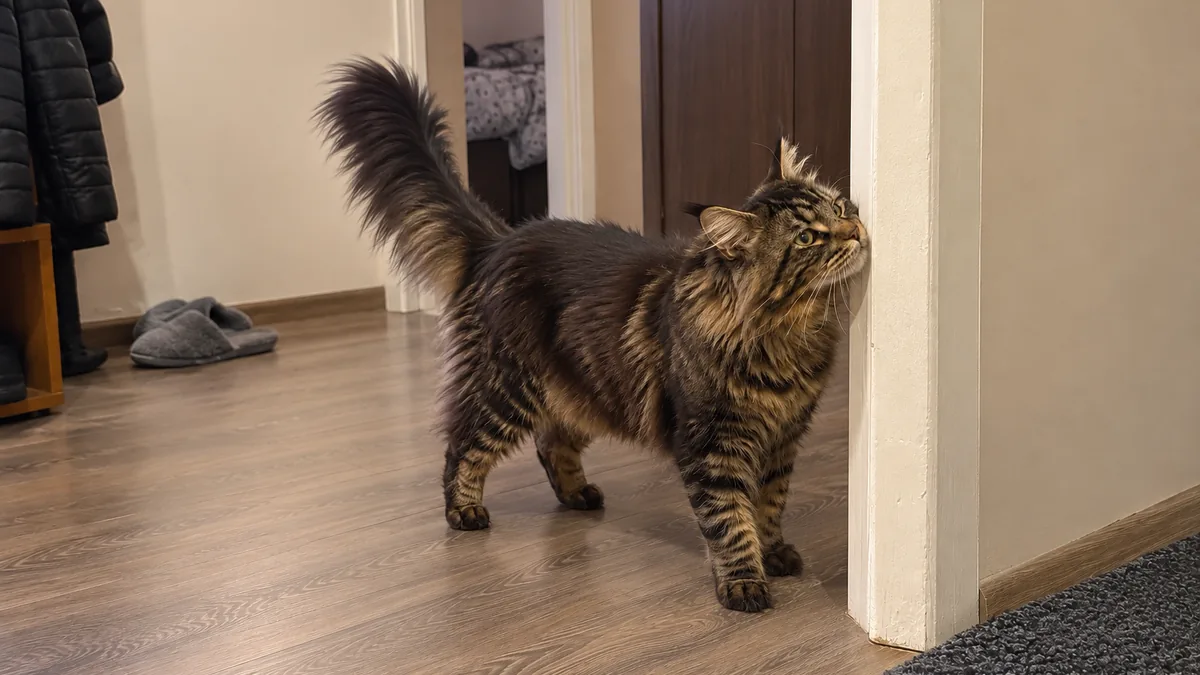
Where to start
Start with a vet check to rule out a urinary problem, and get an unneutered cat neutered. Then work out what makes your cat feel threatened, most often other cats or a change at home, and reduce it. Clean every mark with an enzymatic cleaner or biological washing powder, never ammonia. Don't punish your cat or spray them with water. It makes them more anxious and more likely to spray.
What is cat spraying, and how is it different from peeing?
Spraying is marking with urine. A cat who is simply peeing squats and leaves a puddle, usually somewhere quiet. A cat who sprays backs up to something upright, such as a wall, a door or a curtain, and stands with their tail straight up and quivering. Then comes a short squirt backwards, sometimes with a little treading of the back legs.
The amount is small, usually less than 2 ml according to International Cat Care, but it smells sharp, because spray carries extra chemical messages for other cats. Often you notice the smell before the mark, which may be a small trickle on a door, a skirting board or a radiator.
Cats tend to choose doors and windows, full-length curtains, radiators and electrical things that warm up and cool down, and anything new or smelling of somewhere else: a suitcase, a handbag, shoes, a coat. Now and then a cat marks something flat, often clothes left on the floor.
Puddles on the floor are more likely to be peeing outside the litter tray. That has different causes and different fixes, so it helps to know which one you're dealing with.
Start with a vet check
See your vet before you change anything else. Urinary problems such as feline lower urinary tract disease, or kidney disease, can be behind spraying, and the vet may ask you to collect a urine sample. Cats are good at hiding pain and illness, so a cat who seems fine can still be unwell.
Watch the litter tray as well. Cats Protection says to book a vet appointment if your cat strains, cries or seems in pain when peeing, passes only small amounts, or has blood in their pee. A cat who can't pass any pee at all is an emergency and needs a vet straight away. Males are much more prone to this.
Male and female cat spraying, and what neutering does
Any cat can spray, male or female, neutered or not. Unneutered males do it most, because their spray also tells rivals and females that they're around. Unneutered females spray too, especially when they're in season.
Neutering usually cuts spraying down a lot, in males and females alike. If a young cat who hasn't been neutered starts spraying, International Cat Care says the most likely cause is that they're becoming sexually mature, and neutering should stop it. Your vet can advise on timing.
Why is my neutered cat spraying?
Neutering removes the mating reason. The others stay. Around 10% of neutered males and 5% of neutered females still spray, and the more cats share a home, the likelier it gets.
Battersea calls this reactional spraying. It follows a change in your cat's world, to the home itself or to who lives in it, and it's most likely when the change reaches the core area where your cat eats, sleeps and plays. Confident or nervous, male or female, any cat will spray if they feel they need to.
Why is my cat spraying in the house? Look for the trigger
Cats rub their cheeks on things where they feel safe and spray where they feel threatened. So a mark indoors tells you that something about that spot worries your cat. When the smell fades, they come back to top it up.
The place is a clue. Marks on the cat flap, outside doors or windows point to a threat from outside, often another cat. Marks on inside doorways and in hallways point to tension with another cat at home, since that's where they cross paths.
Changes count, even small ones. The ASPCA's list runs from a new baby, a new pet or building work to a new coat or groceries in an unusually large paper bag. A change of diet, too little play and the smell of new furniture or carpet can do it too. Strong, unfamiliar smells unsettle some cats, so put away plug-in air fresheners and scented candles.
Keep a short diary of where and when you find marks, and what happened that day. If you have more than one cat, don't assume you know who it is. Another cat may be doing it more quietly. A camera or phone pointed at the usual spot can show you. If you'd like a plan to follow, Lapka has a programme for toileting and marking problems that's built around your cat and adjusts after every session.
Cats outside: block the view and guard the cat flap
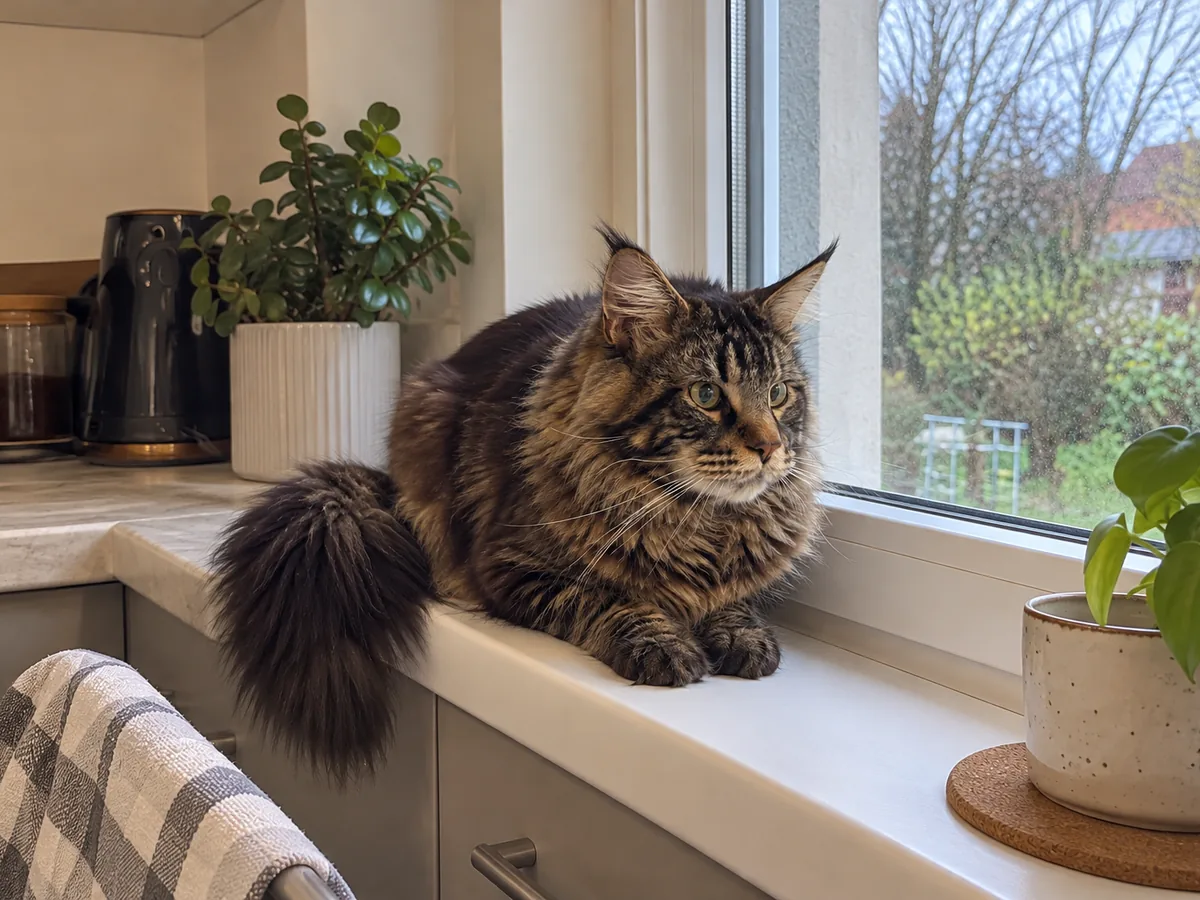
If the marks gather by windows and outside doors, take away the view. Cover the glass with something semi-transparent. On full-length windows and glass doors, cover the lower part with opaque static film or card, so your cat can't see out and cats outside can't see in.
If a neighbour's cat comes in through the cat flap, fit a microchip flap that opens only for your cats. A few plant pots around the flap give your cat some cover on the way in and out. You can also make the garden less inviting to visiting cats.
More than one cat: enough of everything
Cats who don't get on rarely show it openly. They take turns on the favourite armchair and keep to different rooms, so the tension is easy to miss. Give each cat their own set of everything, plus one spare, spread around the home: litter trays, food and water bowls, beds, scratching posts, high perches and hiding places.
For three cats, that's four litter trays, in quiet spots with two ways out. Each cat should be able to reach food, water and a tray without passing another animal or anything that scares them, and should always have somewhere to hide.
Play with each cat on their own, in different rooms, with a wand toy. If you've just moved, or your cat is new to the home, keep them to one or two rooms at first and open up the rest gradually.
How to clean cat spray and get rid of the smell
Clean a mark as soon as you find it. If your cat can still smell it, they'll come back to top it up, so the smell has to be neutralised. Covering it with another scent isn't enough.
Blot up what you can first. Then use an enzymatic cleaner made for pet urine, following the label, or the method the RSPCA gives: one part biological washing powder to nine parts water, then a rinse with clean water. On surfaces that can take it, finish with diluted surgical spirit and let it dry naturally. Test a small hidden patch first.
Skip cleaners with ammonia. Urine contains ammonia too, so they can draw your cat back to the same spot. Vinegar is out as well, since it smells like urine, and so are strongly scented products, which may encourage more marking.
A badly soaked rug or cushion can tempt your cat even after cleaning, so throw it out if you can. Pin a cleaned curtain up out of reach for a while, or cover a favourite chair with plastic. Cats don't tend to spray where they eat, so a food bowl or a few treats on the cleaned spot can help.
Cleaning alone may not solve it, though. Your cat may simply pick a new spot.
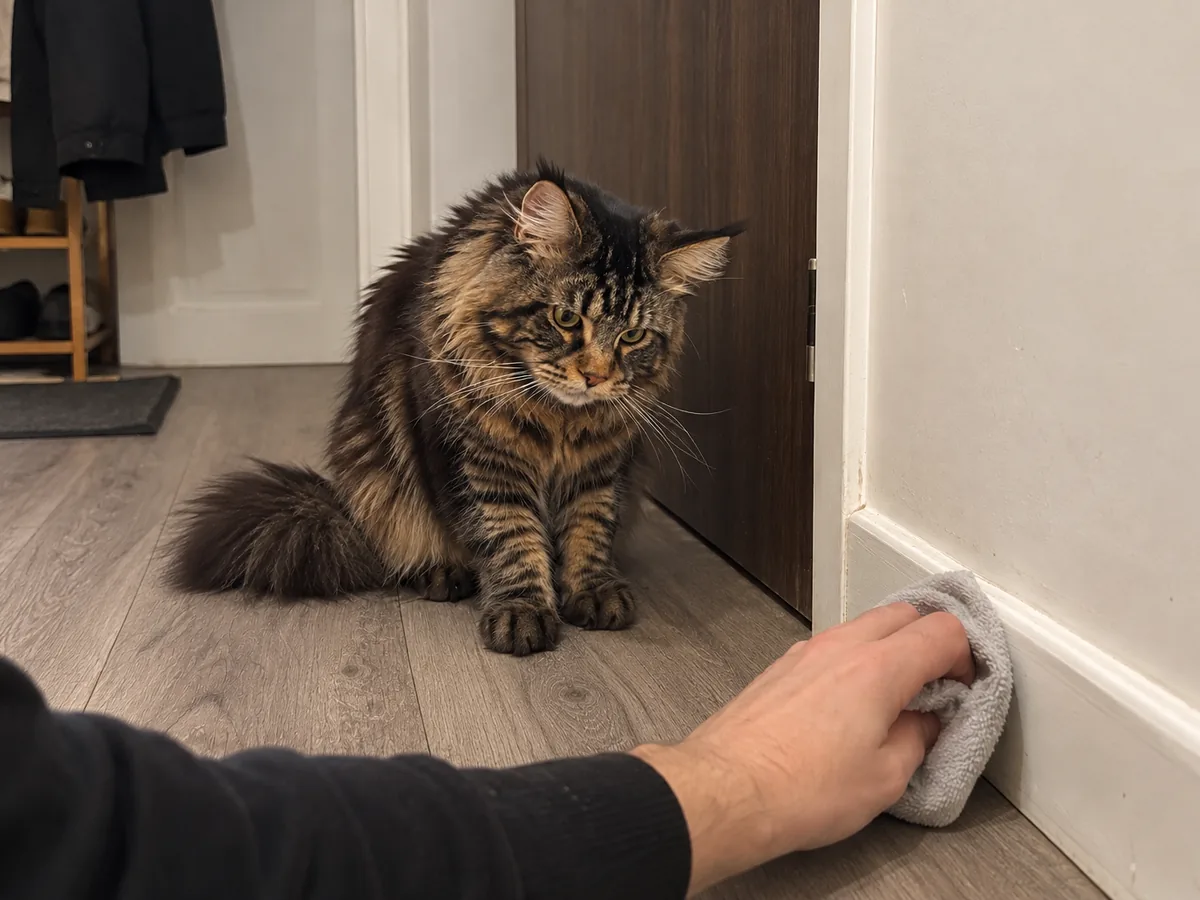
Is spraying a cat with water bad?
Yes. Spraying water at your cat, telling them off or rubbing their nose in the mark are all punishment, and Cats Protection says punishing a cat for spraying never helps and may lead to more of it. Your cat was already anxious. Punishment makes them more anxious and more likely to spray.
Stay calm and treat your cat as you normally would. Cats pick up on changes in how you behave, and a cat who feels unsettled may spray more.
When to get help from a vet or behaviourist
If your vet finds nothing medical and the spraying carries on, ask them to refer you to a qualified cat behaviourist. Spraying is hard to untangle on your own: there are often several causes, and some, like the cats next door, are out of your hands. A behaviourist will usually visit you at home, go through your cat's history and suggest changes that fit your situation.
If your vet suggests medication, Cornell's Feline Health Center is clear that it can only be one part of the plan, used together with changes at home.
Leo's week, from his owner's notes
Mon: sharp smell by the back door, low on the frame. The ginger cat from next door was on the fence this morning.
Wed: a mark on my gym bag by the front door. It had been at the gym with me all day.
Thu: back door again. Ginger cat on the fence again. Kitchen blinds half down from tonight.
Three marks in four days, all by a way in from outside, two on days the neighbour's cat was around. That pattern is what you and your vet need to see.
When it does not go to plan
Is my cat spraying out of spite?
No. Cats Protection's behaviour guide says cats don't have a moral sense of right and wrong, and Cornell points out that cats don't find urine disgusting, so they'd hardly use it as a weapon. Spraying indoors is a sign of stress. Read it as a message about what's bothering your cat.
My cat backs up and quivers their tail, but nothing comes out. Is that spraying?
It's called pseudo-spraying: the whole routine without any urine. Cats Protection says it can do the same marking job for some cats, while others do it as a greeting or when they're very worked up.
Does a cat who sprays still use the litter tray?
Usually, yes. Cats who mark still use their trays for peeing, so a well-used tray doesn't rule spraying out. Look at where the marks are and whether they're on upright surfaces.
How can I tell which of my cats is spraying?
Keep a diary and point a camera at the usual spot. If that doesn't settle it, your vet can give one cat fluorescein, a harmless dye that makes urine glow blue under ultraviolet light for about 24 hours. Keeping your cats apart one at a time for a while is another way to find out.
When should a kitten be neutered so they don't start spraying?
International Cat Care recommends neutering at around four months. Kittens can be sexually mature as early as four months, though usually at around five or six. Ask your vet what suits your kitten.
Will cat spraying stop on its own?
It tends to come and go with whatever is stressing your cat. It often returns, and the longer you wait, the more complicated it gets, so mention it to your vet even if it has stopped.
Do pheromone diffusers help with spraying?
Possibly. Pheromone therapy may help lower anxiety, and a synthetic feline pheromone diffuser is one of the things International Cat Care suggests while you wait to see a behaviourist. It doesn't remove the trigger, so use it alongside the other changes.
Sources and further reading
- International Cat Care — Urine spraying in cats
- International Cat Care — Why do I need to neuter my cat?
- Cats Protection — Spraying
- Cats Protection — Behaviour focus: spraying
- Cats Protection — The Behaviour Guide
- Cats Protection — Urinary problems in cats
- Battersea — Cat spraying
- RSPCA — Understanding your cat's behaviour
- PDSA — Vet Q&A: How can I stop my cat spraying indoors?
- ASPCA — Urine marking in cats
- Cornell Feline Health Center — Feline behavior problems: house soiling